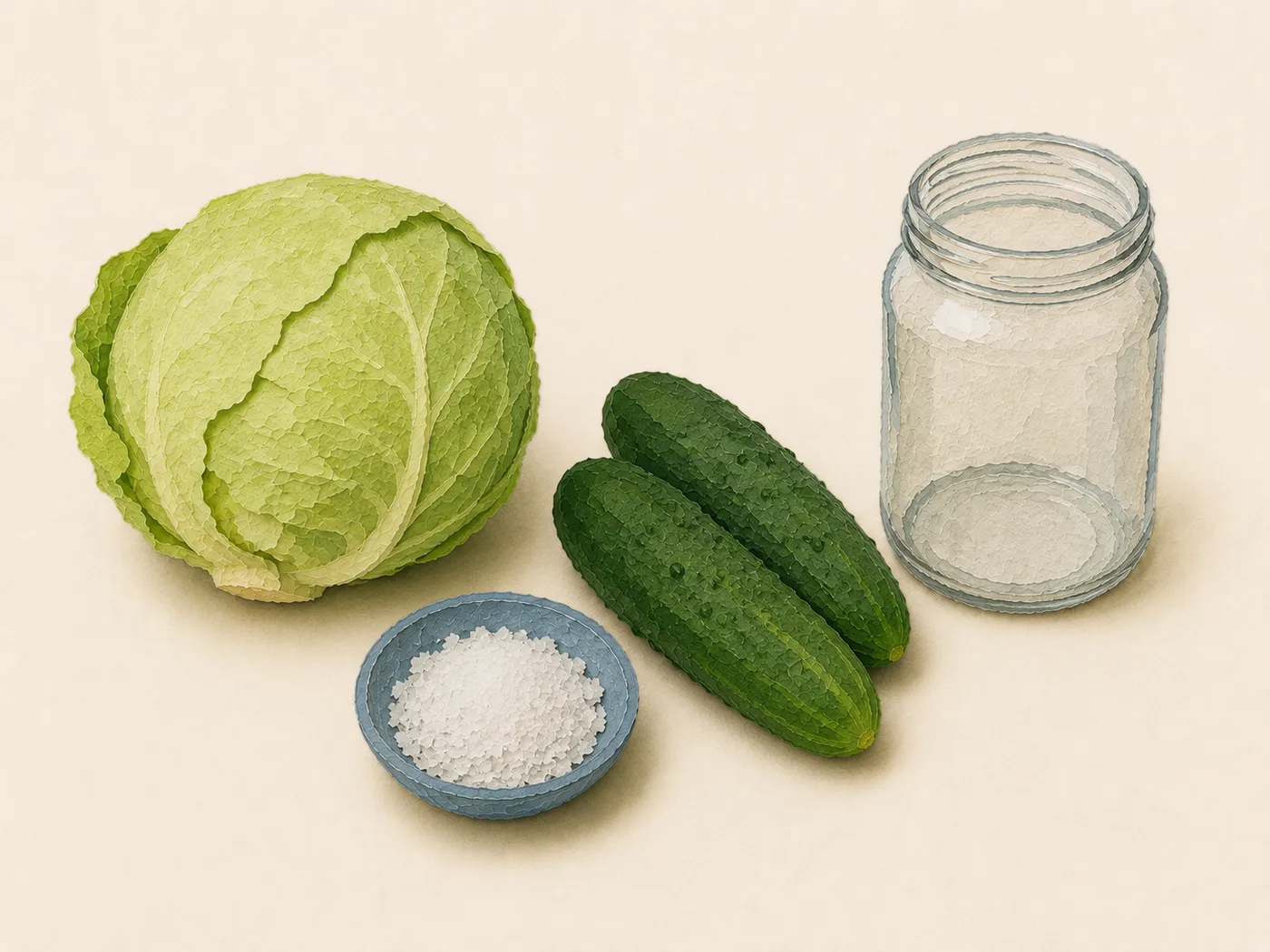
Salt curing is the oldest EE preservation technique: pack vegetables with salt, weigh them down, and let time do the rest. The salt draws out moisture, creates a natural brine, and establishes the conditions for lacto-fermentation. The result — whether sauerkraut, salted mushrooms, or fermented cucumbers — is shelf-stable for months and develops a sour depth that no quick vinegar pickle can replicate.
Ingredients
- Vegetables for curing: cabbage (shredded), cucumbers (whole), or mushrooms (cleaned)
- Non-iodized coarse salt (approximately 2% of vegetable weight)
- Filtered or boiled water, cooled (for brine if needed)
- A clean glass jar or crock
- A weight to keep vegetables submerged
Instructions
- 1Weigh your vegetables. Calculate 2–3% of that weight in salt (20–30 g per kg).
- 2Shred, slice, or leave whole depending on the vegetable.
- 3Toss with salt and massage firmly until the vegetable begins to release liquid.
- 4Pack tightly into a clean jar or crock, pressing down hard after each addition so the vegetables are below their own liquid.
- 5If the liquid does not cover the vegetables within 1–2 hours, add a small amount of 2% brine (20g salt per liter of water) to top up.
- 6Place a weight on top to keep everything submerged. Cover loosely with cloth.
- 7Keep at room temperature (18–22°C) for 3–7 days for active fermentation, tasting daily.
- 8Once sour to your liking, move to the refrigerator. The ferment slows dramatically but does not fully stop.
Cook's Note
Always ferment under weight with the vegetable fully submerged below the brine line. Air contact above the brine breeds kahm yeast or mold — not dangerous but off-flavored. For quick refrigerator ferments, use 2% salt; for long-term preservation, use 3–4%. Taste regularly once the ferment enters the target window; active fermentation continues until you refrigerate it and will overshoot if left at room temperature too long.
How to Use This
Use this method for sauerkraut (shredded cabbage, 2–3% salt, 1–2 weeks), lacto-fermented cucumbers (whole small cucumbers, 2–3% brine, 1 week), and salted milk mushrooms (high-salt cold cure, 4–8 weeks under refrigeration). The fermented brine is an ingredient itself — save it for rassolnik soup, dressings, and direct seasoning.
Why This Method Works
Salt at 2–3% by weight suppresses harmful bacteria while allowing Lactobacillus, naturally present on vegetable surfaces, to convert sugars to lactic acid. The weight keeps the vegetable submerged below its own brine, preventing surface mold. Temperature affects pace: warmer (18–22°C) ferments faster; cooler slows it. For milk mushrooms, the technique is a cold-cure rather than active fermentation: higher salt draws moisture and cures the texture over weeks in a cold environment, producing a firm, briny result without the pronounced sour note of sauerkraut.
Make It Yours
- Add caraway seeds to sauerkraut for the Polish and Czech style.
- Add dill seeds, garlic, and black currant leaves to cucumber ferments.
- Add a whole dried chili for heat.
- Use a ceramic crock instead of glass for a more traditional result.
- For a faster ferment, keep at 22–24°C; for a slow, more complex ferment, keep at 16–18°C.